

Another Boy With Pneumonia
Today María brought her son José to see me. José is 3-and-a-half years old. María said he had been coughing since the day before and his body felt very cold. I used a timer to count his breaths, and found he was breathing 47 breaths per minute. That is rapid breathing. At his age, 40 would be normal. It meant he had pneumonia. But it was good that María brought José to see me quickly, before the pneumonia got worse, so I was able to treat him and he didn’t have to go to the local health post. People here do not like to go to the health post because it’s so far away. The roads to our village are not paved, so it takes about 3 hours to get to the health post – 1 hour walking and then 2 hours on the bus. That’s a long trip with a sick child.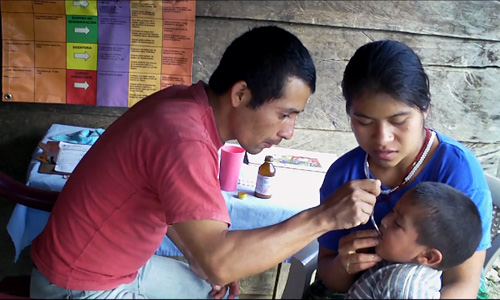
I gave José an antibiotic call Amoxicillin. I told María to give it to him every 8 hours and showed her how to measure it and mix it, with boiled water, so it’s safe. I also explained to her that after José is finished with the Amoxicillin, she will need to give him another medicine called Acetaminophen for his fever. I showed her a chart that explains all this. He gets 1 tablespoon of Amoxicillin every 8 hours for 7 days, plus 2 Acetaminophen tablets over 3 days. I also explained how important it is for him to continue eating good food and to have hot drinks with his food. I warned her that if she didn’t take good care of her son, he could get severe pneumonia. I showed her a picture of a child with severe pneumonia. You can tell that a child has severe pneumonia when you can see the ribs sticking out of their stomach when they breathe, like in the picture. Also, their breaths are faster than usual. I cannot treat a child with severe pneumonia, so they have to go to the health post.
I urged María to check José at home to see if he is getting better. I told her to check his stomach and notice if he is breathing faster. Another thing to look for is if she sees a hole between his ribs, because he is sucking in his breaths too deep. This would mean he’s getting worse and having complications. He might be getting severe pneumonia. I said: “But if you give him the medicine as I told you, every 8 hours – even if that means you have to wake up late at night and get up early in the morning, and wake José up to give him his medicine – then he will get better.” I also told her: “It’s good that you came to see me right away when you saw that José was sick. A healthy child is supposed to have 40 breathes per minute, but José now has 47. If you had waited until tomorrow, he would have had 55 breathes per minute, and another day would have been even worse, and maybe we would see the ribs sticking out like I showed you in the picture and the hole in his stomach every time he breaths.”
“So again,” I said. “This was very good that you brought him to me today.”
María was worried that the medicine might give José diarrhea, but I assured her it would not. “This medicine will not give him any other problem,” I said. “It will only heal him. It will cure his pneumonia. And for the fever you will have to give him these tablets.” I asked her to repeat to me the instructions for how to give the medicine. She repeated it correctly. “Today is Friday,” I said. “So on Sunday I will visit you at home to check on José and see how he is doing. I will check to see if you have been giving him the medicine. So try to feed him. If you have plantains give him those … and eggs, beans with rice, anything he will eat. This will make him feel better and with the help of the medicine he will get better. I’m sure that by Sunday, your son will be fine.”
Information concerning Save the Children Federation, Inc., including financial, licensing or charitable purpose(s) may be obtained, without cost, by writing to Save the Children Federation, Inc., Assistant Corporate Secretary, 54 Wilton Road, Westport, Connecticut 06880, or by calling 1-800-728-3843. Legal Disclosure

